







arXiv founder Ginsparg wins Einstein Foundation Berlin Award
The inaugural Einstein Foundation Berlin Award for Promoting Quality in Research by the Einstein Foundation has been awarded to Paul Ginsparg, professor of physics in the College of Arts and Sciences and professor of information science in the Cornell Ann S. Bowers College of Computing and Information Science, for his work in developing arXiv.org, the first platform to make scientific preprints immediately available globally.

Three professors elected as APS fellows
Kyle Shen, Kin Fai Mak and Lawrence Gibbons named APS fellows.
Forces That Drive the DNA Highway
Motor proteins carry out vital biological processes as they travel along our DNA strands. Michelle Wang investigates the mysteries of how they move.

Masks protect better than distancing, study finds
New research shows the maximum risks of being infected by the coronavirus for different scenarios with and without masks.
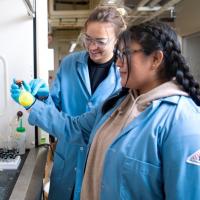
Nexus Scholars Program applications now open
The program connects undergraduates in A&S with opportunities to work side by side on research with Cornell faculty from across the College.


arXiv hits 2M submissions
The research-sharing platform is a free resource for scholars around the world in fields including physics, math and computer science, who use the service to share their own cutting-edge research and read work submitted by others.

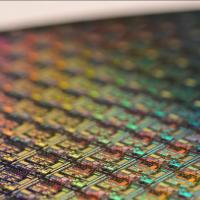
Semiconductor demonstrates elusive quantum physics model
With a little twist and the turn of a voltage knob, Cornell researchers have shown that a single material system can toggle between two of the wildest states in condensed matter physics.
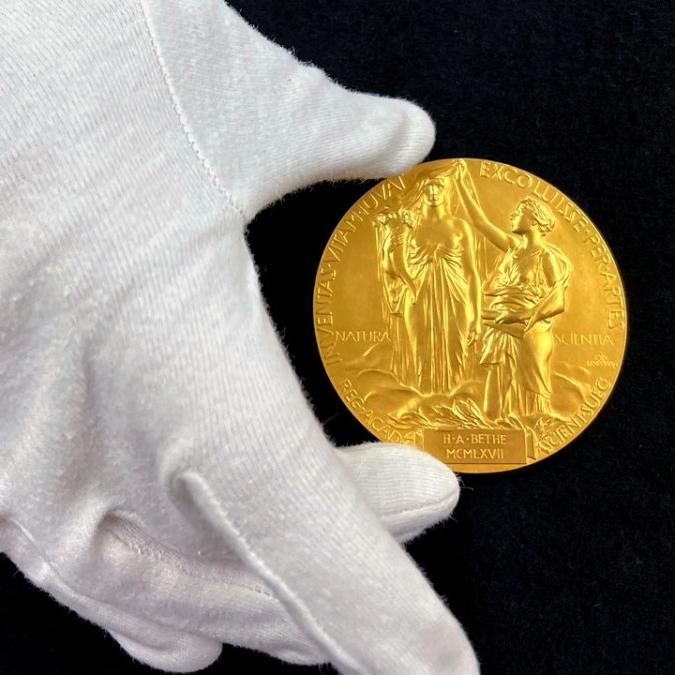
Hans Bethe’s Nobel Prize medal given to library
Bethe earned the medal for his theory on the energy production of stars. It now holds a special place in the library among the physicist's papers from his 60-year teaching career at Cornell.
‘Lab on a chip’ can measure protein-DNA interactions
New nanophotonic tweezers developed by Cornell researchers can stretch and unzip DNA molecules as well as disrupt and map protein-DNA interactions, paving the way for commercial availability.

Gender bias in lab groups not rooted in personal preference
The finding shows there is potential for instructional interventions that could correct the gender inequity in physics labs.